
The founding of Fonda, Iowa
Fonda is a small incorporated city in Pocahontas County, northwestern Iowa, situated along Cedar Creek in the agricultural landscape of the state's northwestern prairie region.
The community originated with construction of the Iowa Falls and Sioux City Railroad, which reached Cedar Creek in the spring of 1870. The railroad opened the surrounding prairie to settlement, agricultural development, and commercial transportation.
John I. Blair, a railroad promoter and landowner, arranged for Frederick Hess of Fort Dodge to survey and plat the new community. The original town plat was recorded on September 13, 1870.
The settlement was initially named Marvin, honoring Marvin Hewitt, an official of the Illinois Central Railroad.
Early construction included a blacksmith shop, stores, residences, and facilities supporting the railroad and the neighboring farms. The original town developed on the east bank of Cedar Creek, with Main Street extending northward from the railroad.
How Marvin became Fonda
The community's change of name in 1874 provides its most interesting connection to Fonda family history.
During its first years, the name Marvin caused confusion with Manson, another Iowa railroad community. Mail intended for one settlement was sometimes misdirected to the other.
According to historical accounts preserved in the Fonda Family History archive, A. O. Garlock and George Fairburn consulted a postal directory to identify a distinctive replacement name.
They selected Fonda, apparently because the directory listed an existing community of that name in western New York.
The namesake was Fonda, New York, a Mohawk Valley village named for Douw Jellis Fonda (1700–1780), an early settler and trader associated with the former Dutch settlement of Caughnawaga.
The Iowa community therefore acquired the Fonda name indirectly through the New York village, rather than through a documented Fonda family settler.
Growth of the railroad town
As the settlement expanded, Fonda developed into an agricultural trading center serving farmers throughout Cedar Township and the surrounding region.
The railroad provided connections to regional markets, allowing local producers to transport grain, livestock, and other agricultural products. Businesses grew around the depot and Main Street, including general stores, banks, hotels, workshops, and professional services.
The community also developed schools, churches, newspapers, and civic organizations.
Fonda's incorporation was formally recognized by the Iowa legislature in March 1884.
A particularly valuable record of the community's early development is Robert E. Flickinger's The Pioneer History of Pocahontas County, Iowa, published in Fonda in 1904 by George Sanborn, longtime editor of the Fonda Times.
The volume contains detailed accounts of pioneer families, railroad construction, businesses, schools, churches, and agricultural development. Its publication in Fonda illustrates the community's important role in preserving the history of Pocahontas County.
Fonda in the twentieth and twenty-first centuries
The city continued as a rural agricultural and commercial community through the twentieth century, although changes in farming, transportation, and regional population patterns gradually altered its economy.
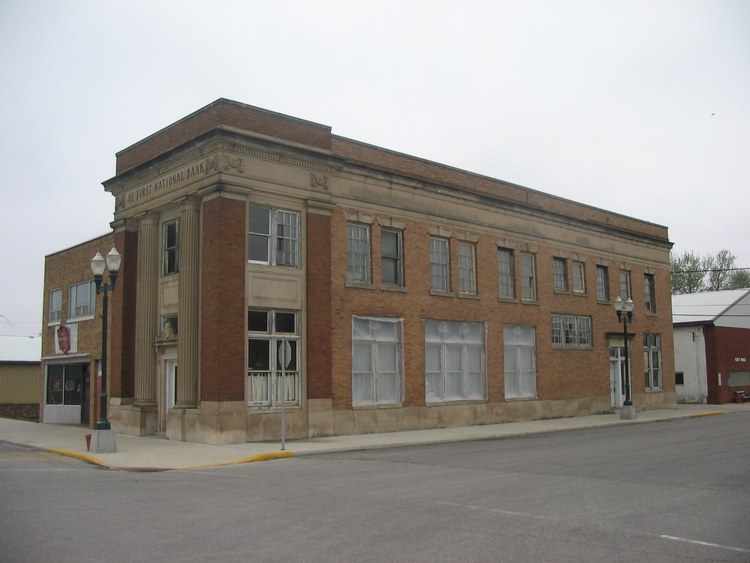
Several historic buildings in the town center preserve evidence of its early commercial development, including the former First National Bank building.
The city's educational history is commemorated by the Fonda Public School Memorial, dedicated in 2018. Today, the community is served by the Newell-Fonda Community School District.
Fonda remains an incorporated municipality, with a population of 636 residents recorded in the 2020 United States Census.
Community parks, local businesses, recreational facilities, and annual celebrations continue to sustain the town's identity.
Connection to the Fonda family
Fonda, Iowa, represents an unusual example of a family surname traveling westward through the naming of communities rather than through direct family migration.
The name originated with Fonda, New York, itself named in recognition of the early Mohawk Valley Fonda family.
When the Iowa railroad community adopted that name in 1874, the surname became permanently established in another part of the United States.
No direct role by a documented Fonda family member in the founding or early administration of the Iowa settlement has been established.
The relationship is therefore best understood as a documented indirect naming connection, reflecting the wider geographical influence of the Fonda surname during America's nineteenth-century westward expansion.
Sources and references
- Pocahontas County IAGenWeb — local history and records: Volunteer-maintained Pocahontas County history, genealogy and historical resource directory.
- Pocahontas County Railroad Depots — IAGenWeb: Historical depot photograph collection, including the Illinois Central station at Fonda, Iowa.
- Historic bank building, Fonda, Iowa — Wikimedia Commons: Photograph file page showing the former bank building, photographer attribution and reuse license.
- Robert E. Flickinger: The Pioneer History of Pocahontas County, Iowa (1904). Especially pages 248–252 covering early railroad construction and the founding of Marvin.
- Iowa Secretary of State: List of Incorporated Cities. Confirms Fonda's legal incorporation date.
- Fonda Family History — Places Gallery: Fonda family historical image archive. For the 1874 town naming and railroad-depot history, consult the Pocahontas County sources above.
- Travel Iowa: Fonda. Modern community landmarks and activities.