
A historic Adirondack place-name
Lake Kora is a secluded mountain lake in Hamilton County, New York, near Wakely Mountain and south of Raquette Lake.
The lake has been known by several names during its recorded history, including Lake Tuscarora, Sumner Lake, and Fonda Lake.
The historical Fonda Lake name is specifically documented in the New York State Department of Environmental Conservation's Blue Ridge Wilderness Unit Management Plan, which records these earlier names in its account of the region's history.
Although the name Fonda Lake is therefore historically established, the reason for its adoption has not been identified. No reliable evidence has yet connected it to a specific member of the Fonda family.
William West Durant and the Adirondack Great Camps
During the late nineteenth century, much of the surrounding Adirondack wilderness was owned or controlled by William West Durant, the developer whose distinctive Great Camps helped establish a new style of rustic resort architecture.
Durant acquired substantial properties in the Totten and Crossfield Purchase during the 1880s and developed several elaborate wilderness retreats, including Camp Pine Knot, Camp Uncas, and Great Camp Sagamore.
On the property surrounding the lake then commonly known as Sumner Lake, Durant established an early hunting camp.
In 1897, he sold approximately 1,027 acres surrounding the lake to Timothy L. Woodruff, then lieutenant governor of New York.
Kamp Kill Kare and the renaming of the lake
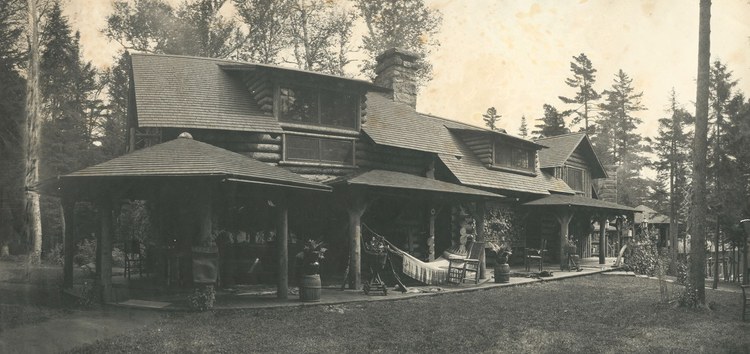
In 1898, Woodruff developed the property into an elaborate private retreat known as Kamp Kill Kare.
The camp incorporated rustic log and stone architecture, landscaped grounds, recreational facilities, and accommodations for family members and distinguished guests.
The lake was subsequently renamed Lake Kora in honor of Woodruff's wife, Cora. The distinctive spelling with a K reflected the stylized naming tradition also evident in Kamp Kill Kare.
The estate became one of the most elaborate of the Adirondack Great Camps, demonstrating how the region's wealthy seasonal residents combined an appreciation of wilderness scenery with extraordinary architectural and recreational amenities.
Later ownership and preservation
In 1913, Alfred G. Vanderbilt acquired Kamp Kill Kare from Woodruff. The property subsequently passed to Francis P. Garvan and his wife, Mabel Brady Garvan.
A major fire in 1915 destroyed portions of the complex, leading to extensive reconstruction and expansion.
The distinguished architect John Russell Pope, later responsible for the Jefferson Memorial and National Gallery of Art in Washington, D.C., designed several of the rebuilt and additional structures.
The property continued as a privately owned Adirondack estate during the twentieth and twenty-first centuries. Its surviving buildings preserve an important example of the Great Camp architectural tradition.
Historical photographs, maps, and architectural studies document the estate's development from Durant's early wilderness holdings to one of the region's best-known private retreats.
Connection to the Fonda family
For Fonda family historians, the lake's principal significance is its documented historical use of the name Fonda Lake.
Unlike Fonda Lake in Brighton, Michigan, which has an established connection to Lewis B. Fonda and his family, the Adirondack lake's earlier name has not been linked to an identifiable Fonda ancestor.
The historic name may eventually be explained through property records, early surveys, estate correspondence, or local place-name research. Until then, it is appropriate to preserve the name in the Fonda Family History collection while distinguishing documented geographic history from an unproven genealogical association.
Today, the lake is known as Lake Kora, but its earlier designation as Fonda Lake remains part of the recorded geographical history of the Adirondacks.
Sources and references
- Blue Ridge Wilderness Unit Management Plan — NYS DEC: Official Adirondack land-management report with historical place names and land-use background.
- Adirondack Camps Historic Context — National Park Service: Historic-context study of Adirondack Great Camps and their architecture, including the Durant tradition.
- Lake Kora — Adirondack Architectural Heritage: Architectural and historical tour description of the Lake Kora Great Camp.
- Inside Lake Kora — Adirondack Life (2022): Illustrated feature on the Great Camp’s Gilded Age history, buildings and later use.
- Sam Lasher in the Adirondacks, Part 2 — Bucknell History: University history research discussing the Adirondack landscape and historical imagery.
- Kamp Kill Kare / Lake Kora — historical photograph: Historic image preserved in Bucknell’s Adirondack research materials.
- Wakely Mountain quadrangle — USGS topographic map (2010): USGS map placing Lake Kora in its Adirondack geographic setting.
- Historic Lake Kora Great Camp sale — Times Union (2026): News report on the property’s 2026 sale and background of the estate.
- Fonda Genealogy — family-history database PDF: Published family genealogy for tracing the individuals connected with the Fonda name.
- Digitized genealogical document — Seeking My Roots: Scanned family-history document in a genealogy repository; consult the PDF for its bibliographic details.
- New York State DEC: Blue Ridge Wilderness Unit Management Plan — historical names, 1897 land transfer and development chronology.
- National Park Service: Adirondack Camps Historic Context — Durant's architectural influence and the Great Camp tradition.
- Bucknell University: Adirondack Forest Preserve Research — Stoddard's circa-1900 photograph.
- Adirondack Life: Inside Lake Kora — additional estate history.