
A former Oklahoma community
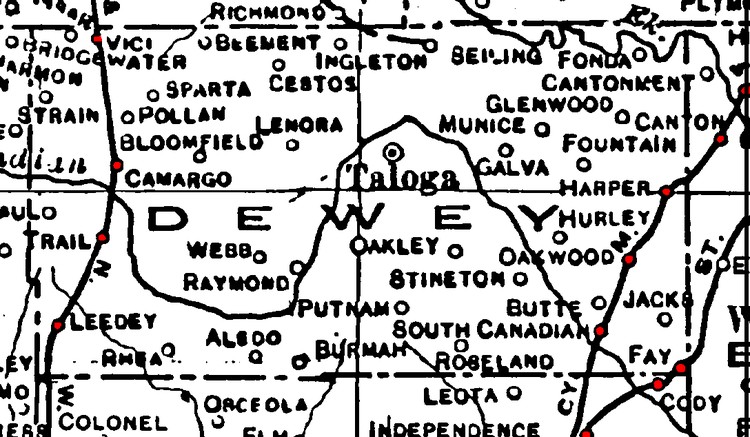
Fonda was a small rural settlement in northeastern Dewey County, Oklahoma, approximately seven to eight miles east of Seiling. Once home to a general store, blacksmith shop, post office, and several residences, the community has since disappeared as an identifiable village.
Its location is preserved in historical county maps and federal geographic records, at approximately 36.14754° north latitude and 98.75898° west longitude.
Fonda developed during the period of agricultural settlement following the opening of the former Cheyenne and Arapaho Reservation to non-Indigenous homesteading in 1892.
Although the precise founding date of the settlement has not been established, its documented postal history begins in the early twentieth century.
The Fonda post office
The Fonda post office was established on March 5, 1903, during the Oklahoma Territorial period. James A. Benjamin was appointed its first postmaster, according to George H. Shirk's research in federal postal records, published in The Chronicles of Oklahoma in 1952.
The post office continued operating after Oklahoma achieved statehood in 1907.
It was discontinued on December 30, 1916, with mail service transferred to Cantonment.
The community appears on a 1915 map of Dewey County published by the American Geographic Institute. The map identifies Fonda east of Seiling, providing contemporary evidence of the settlement's location.
The Tyree family and Fonda General Store
A local recollection preserved in The Okie Legacy describes Fonda as a small settlement containing a general store, blacksmith shop, post office, and several residences.
The general store was operated by the Tyree family and served residents of the surrounding farming community.
A later obituary for Paul Bailey Tyree (1921–2017) confirms his family's association with the community. Paul grew up in Fonda, where his parents, Herbert and Nellie (Carpenter) Tyree, operated the Fonda General Store.
This family history establishes that Fonda remained a functioning rural community after the post office closed in 1916.
Diamond School and rural life
Near Fonda and the Canadian River was a small rural school known as Diamond School.
A former resident's recollections describe a one-room schoolhouse with a single teacher responsible for several elementary grades. The building had a wood-burning stove, kerosene lighting, a windmill supplying drinking water, and a barn for pupils who traveled to school on horseback.
According to this retrospective account, approximately twenty children attended the school in 1928, many of them Native American.
Although these details have not been independently verified against surviving school registers, they offer an interesting glimpse of educational and community life in the region.
The origin of the Fonda name
The origin of the settlement's name remains uncertain.
George H. Shirk's Oklahoma Place Names explains that fonda is a Spanish word meaning an inn or lodging house.
This linguistic explanation provides a possible origin distinct from the Dutch-American Fonda surname. However, no contemporary record has yet been identified establishing who selected the name or the circumstances of its adoption.
Unlike Fonda, Iowa, and Fonda, North Dakota, which have documented naming connections to Fonda, New York, there is no established genealogical or naming relationship between Fonda, Oklahoma, and the documented Fonda family.
Historical significance
Today, Fonda is principally remembered through its postal records, historic maps, genealogical recollections, and the family histories of people who lived there.
Its disappearance reflects the changing geography of rural Oklahoma as transportation, postal service, agriculture, and population patterns evolved during the twentieth century.
For the Fonda Family History website, the community represents a verified occurrence of the Fonda place-name, while its precise naming origin and any association with the family remain subjects for further research.
Sources and references
- Dewey County 1915 map — OKGenWeb: Historical county map useful for locating the former Fonda community.
- Dewey County towns index — OKGenWeb: Town-name matrix for finding Dewey County communities, including former settlements.
- First Post Offices Within the Boundaries of Oklahoma — G. H. Shirk (1952): Chronicles of Oklahoma article listing territorial-era post offices from federal records.
- The Post Offices of Oklahoma, 1907–1965 — G. H. Shirk (1966): Chronicles of Oklahoma study of post offices from statehood through 1965.
- Fonda, OK — The Okie Legacy (2009): Reader reminiscences and questions about the former Fonda community and Diamond School.
- Fonda, OK: “Indians Here July 4th, 1911” — The Okie Legacy: Article reproducing an 1911 newspaper notice and discussing Fonda’s former post office.
- Watonga-area historical news archive: Syndicated regional-history posts that provide additional local context for western Oklahoma.
- Dewey County — Encyclopedia of Oklahoma History and Culture: County history, settlement patterns and geographic background.
- George H. Shirk, First Post Offices Within the Boundaries of Oklahoma (1952): establishment date and first postmaster, page 61.
- The Post Offices of Oklahoma, 1907–1965 (1966): closing date and mail transfer.
- The Okie Legacy: Fonda, Oklahoma (2009) — retrospective community and school description.
- Oklahoma Historical Society: Dewey County — regional settlement history.