
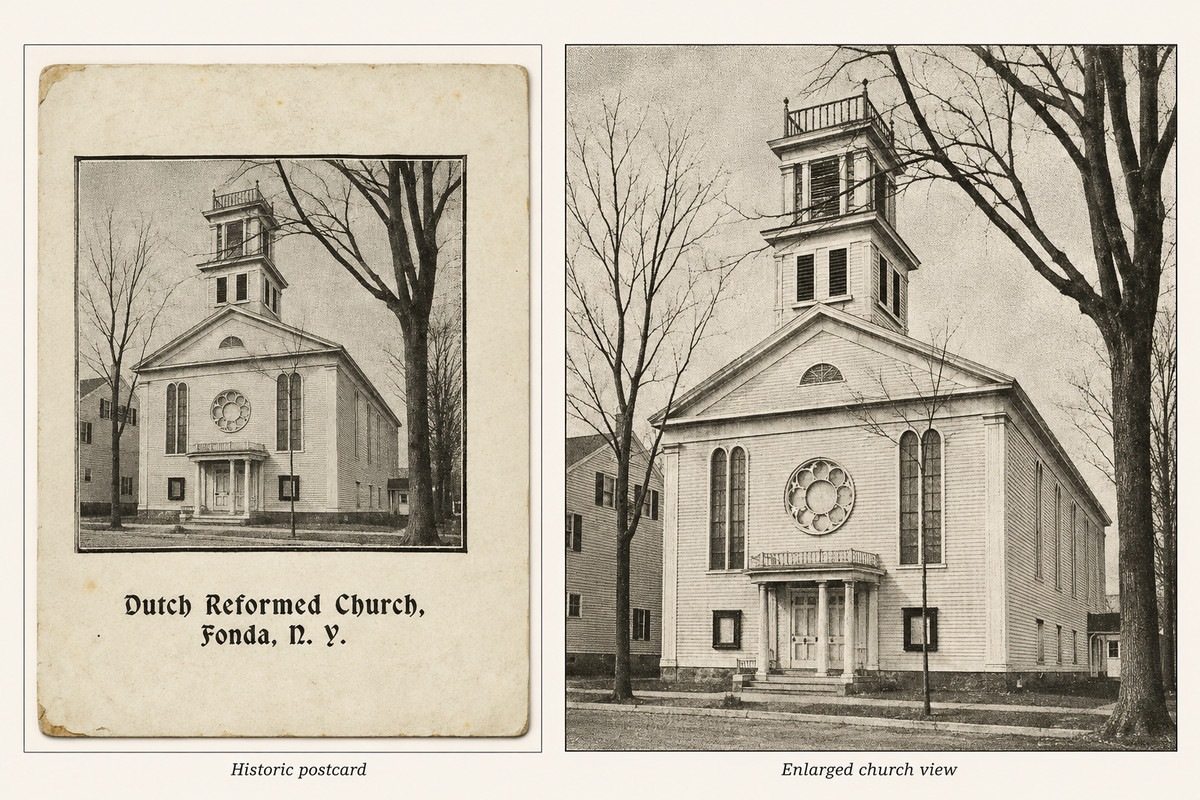
Open full-resolution postcard and church illustration (1536 × 1024)
Historical background
The Fonda Reformed Church, at 19–21 Broadway in Fonda, New York, traces its origins to the Reformed Protestant Dutch Church of Caughnawaga, organized about 1758 in the Dutch settlement along the Mohawk River.
The first substantial church building was erected in 1763, reportedly with financial assistance from Sir William Johnson. Built of stone, it stood in the eastern portion of present-day Fonda, then known as Caughnawaga. The church became an important center of worship and community life for the Dutch families who settled along the Mohawk Valley during the colonial period.
Among its early ministers was the Rev. Thomas Romeyn, who served from 1772 until 1794. His successor, the Rev. Abraham Van Horne, conducted services in both Dutch and English, reflecting the gradual transition from the Dutch language among the region's established families.
Fonda family connection
The church's history is closely associated with the early Dutch families of Caughnawaga, including the Fondas, Wemples, Vroomans, and other families whose descendants remained in the Mohawk Valley.
A particularly important family connection was the Rev. Jacob Douw Fonda (1793–1856), identified in Fonda family historical records as pastor of the Dutch Reformed congregation from 1836 to 1842. His ministry preceded a period of congregational division and the construction of a new church building in 1843.
Beyond its pastors and congregation, the church's surviving registers are valuable resources for tracing the Fonda family and its relatives. Records of baptisms, marriages, membership, church officers, and deaths document several generations of families in Caughnawaga and Fonda.
The church buildings
The original stone church of 1763 no longer survives. Its former location in eastern Fonda is commemorated by historical markers, including a memorial erected by the Caughnawaga Chapter of the Daughters of the American Revolution.
A new church building was erected in 1843 near Center and Railroad streets and was subsequently moved to the Broadway location during the 1860s. Historical photographs and postcards preserve the appearance of the later church, with its distinctive facade, arched windows, and tower.
The church's long history illustrates the transformation of Caughnawaga from an eighteenth-century Dutch settlement into the incorporated Village of Fonda.
The church today
Fonda Reformed Church remains an active congregation at 19–21 Broadway. Its building and historical records provide an enduring connection between the present-day community and the generations who worshipped in Caughnawaga during the colonial and Revolutionary periods.
For Fonda family researchers, the church is significant both as a surviving historical institution and as the custodian of a religious and genealogical tradition reaching back to the family's earliest years in the Mohawk Valley.
Sources and references
- Dutch Reformed Church, Fonda — historic image, Wikimedia Commons: Historic church image with its file description and credit or rights information.
- Montgomery County religious records — NYG&B: Online religious-records collection useful for researching Fonda baptisms, marriages and church history.
- Fonda Reformed Church — congregation website: Information about the congregation, its activities and continuing history.
- Clergy — The Fonda Blog: Biographical listing of Fonda family ministers, including Jacob Douw Fonda’s pastorate.
- History of Fonda — village historical overview: Municipal-history page giving context for the village and its churches.
- New York Genealogical and Biographical Society: Church records. Includes the 1758–1858 Caughnawaga registers transcribed by Royden Woodward Vosburgh in 1917.
- Village of Fonda historical account. Describes the original church and subsequent building history
- Fonda Reformed Church official website. Confirms the current address and congregation
- Presbyterian Historical Society postcard. Image provenance and public-domain status