
From agricultural fairgrounds to racing speedway
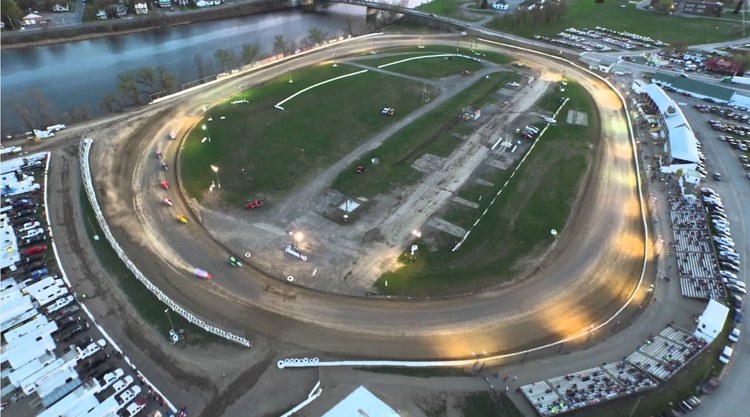
Fonda Speedway is located at 21 South Bridge Street in the Village of Fonda, Montgomery County, New York. Known as the “Track of Champions,” it is one of the region's most celebrated dirt-track racing venues, occupying the historic Montgomery County Fairgrounds beside the Mohawk River.
The site's racing history reaches back well before the modern automobile speedway opened in 1953. In 1863, the local agricultural society acquired permanent fairgrounds at Fonda, and in 1868 a half-mile oval was constructed for horse racing. The track hosted horse-racing events during the annual agricultural fair, while the original section of the distinctive covered grandstand was erected beginning in 1876.
Automobile racing began at the fairgrounds in 1927. During the following decades, the grounds gradually developed a motorsports tradition that would eventually become an important part of Mohawk Valley sporting history.
The Track of Champions
The modern Fonda Speedway began its regular stock-car racing program in 1953. Its unusual half-mile dirt oval, historic covered grandstand, and enthusiastic local following helped establish a racing tradition that continues into the twenty-first century.
Fonda attracted national attention when NASCAR's premier division competed there on four occasions. Junior Johnson won in 1955, David Pearson in 1966, and Richard Petty in both 1967 and 1968.
Over the years, the speedway became closely associated with dirt Modified racing. Generations of drivers, including Steve Danish, Pete Corey, Lou Lazzaro, Dave Lape, and Jack Johnson, contributed to the track's reputation and enduring appeal.
The Fonda 200 developed into one of the venue's signature events, attracting leading Modified competitors from across the Northeast.
The Fonda family and the historic site
The connection between Fonda Speedway and the Fonda family reaches back to the earliest European settlement of Caughnawaga, the community that later became the Village of Fonda.
Douw Jellis Fonda (1700–1780), the early settler for whom the village was named, established a home and trading post near the Mohawk River around 1750. Local historical accounts place his trading establishment within the area now associated with the speedway's racing oval.
The surrounding land was therefore associated with the Fonda family's early settlement history long before it became the site of agricultural exhibitions, horse racing, and automobile competition.
This is a historical land association rather than evidence of Fonda family involvement in the establishment or operation of the modern speedway.
Preserving the racing heritage
Fonda Speedway remains an active venue for dirt-track motorsports, with racing programs and special events attracting drivers and spectators from throughout the region.
Its history is also preserved by the Fonda Speedway Museum and Hall of Fame. The museum originated in 1999 in Fultonville and relocated its collection to the Fonda Fairgrounds in 2012, bringing historic racing memorabilia back to the track itself.
For the Fonda Family History website, the speedway represents an unusual combination of family geography and regional sporting heritage. The land associated with Douw Fonda's eighteenth-century settlement became, over succeeding generations, one of New York's best-known dirt racing venues.
Sources and references
- Fonda Speedway — Wikimedia Commons photograph: Image-file page with a view of the track and its licensing details.
- Fonda Speedway — Montgomery County business profile: Local business feature on the speedway and its role in the area.
- Fonda Speedway joins NASCAR Weekly Series (2023): NASCAR announcement describing the speedway’s participation in the 2023 weekly racing program.
- Montgomery County Business Development Center: Fonda Speedway (2023) — current venue history and regional significance.
- Andy Fusco and Lew Boyd, FONDA! An Illustrated and Documented History of the Legendary Fonda Speedway (2002): authoritative historical treatment of the fairgrounds and racing.
- Village of Fonda: Descendants of Douw Fonda Visit the Village — historical relationship between Douw's trading post and the present race track.
- Fonda Speedway Hall of Fame: Museum History — establishment and relocation of the museum.
- The Fonda Blog: Fonda Speedway — existing family website coverage.