
The origins of Fonda Junction
Fonda is a small historic locality in the Town of Swanton, Franklin County, Vermont, approximately three miles north of St. Albans. Originally known as Swanton Junction, it subsequently became known as Fonda Junction and eventually simply Fonda.
The settlement developed around the intersection of important railroad routes and the limestone-quarrying and lime-manufacturing industries that operated in the surrounding area.
The Swanton Historical Society traces lime manufacturing at Swanton Junction to at least 1847, when Charles W. Rich operated a lime enterprise there. The introduction of railroad transportation enabled local lime producers to ship their products to markets across New England.
The locality maintained its own post office from 1867 until 1909.
William Beecher Fonda and the lime industry
The community's connection to the Fonda family is directly documented through William Beecher Fonda (1846–1917), an industrialist and businessman who settled in nearby St. Albans during the early 1870s.
According to an early industrial account cited by historian Victor R. Rolando, Fonda acquired the local lime works in 1872. He subsequently developed a substantial lime-manufacturing business associated with the St. Albans Lime Works.
Rolando's history specifically explains that the locality became known as Fonda Junction because of William Beecher Fonda's lime kilns.
The enterprise reportedly employed more than thirty workers and manufactured approximately 60,000 to 70,000 barrels of lime annually.
The product, known commercially as St. Albans Lime, was used in building construction, plaster manufacture, and industrial processes, including paper production and bleaching.
Fonda's activities in lime manufacturing were part of a much larger business career involving lumber, building materials, utilities, banking, manufacturing, and transportation in northern Vermont.
A railroad and industrial landscape
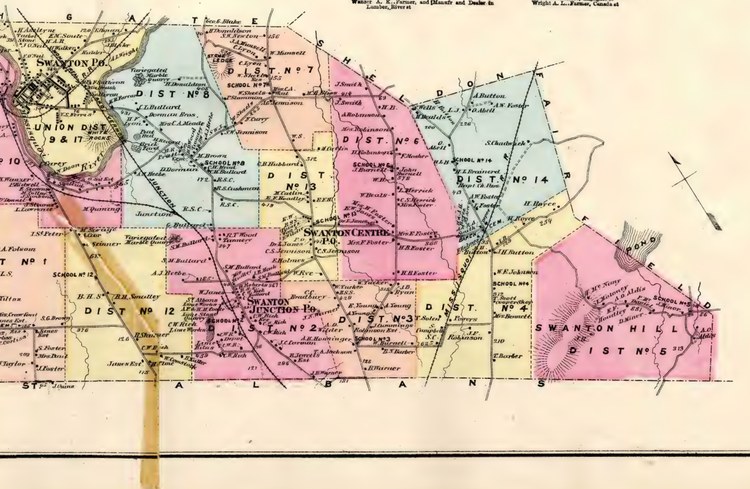
The 1871 Atlas of Franklin and Grand Isle Counties, published by F. W. Beers, depicts Swanton Junction and the surrounding industrial properties.
The map identifies the St. Albans Lime Works, C. W. Rich's lime works, several lime kilns, a limestone quarry, and railroad sidings serving the industrial district.
Although this map predates William Beecher Fonda's reported acquisition of the works, it provides valuable evidence of the industrial setting in which his business subsequently developed.
A historical photograph from approximately 1915 shows freight cars lined up on a Central Vermont Railroad siding to receive lime. The photograph preserves a rare visual record of the locality's industrial activity during the early twentieth century.
A separate aspect of community history is documented in local Catholic parish records. In 1897, St. Anthony's Chapel was established at Swanton Junction near Lime Kiln Road, also serving for a time as a school for approximately forty students.
These institutions illustrate how the railroad junction developed into a small working community with industrial, transportation, religious, and educational functions.
Archaeological remains of the lime works
Although the historic lime industry has largely disappeared, physical evidence of its operations survived into the late twentieth century.
In 1986, an archaeological investigation identified the remains of six lime kilns approximately one-quarter mile west of U.S. Route 7, near the western end of Lime Kiln Road in southern Swanton.
The remains included collapsed masonry, stone foundations, and deteriorating iron kiln structures. The site was documented as FR-178, Fonda Junction Lime Kilns, in the Vermont archaeological inventory.
Photographs published in Victor R. Rolando's 200 Years of Soot and Sweat preserve both the historic industrial facilities and their surviving ruins.
Significance to the Fonda family
Fonda, Vermont, is an especially important geographic connection to the Fonda family because its naming origin is supported by historical evidence identifying a specific family member.
Unlike Fonda, Iowa, which borrowed its name from another community, or Fonda, Wyoming, whose naming origin remains uncertain, Vermont's Fonda Junction is associated with the industrial enterprise of William Beecher Fonda.
The locality provides a tangible record of the family's contributions to nineteenth-century American industry and commerce.
Today, the name Fonda survives on geographic maps of Swanton, preserving the memory of a business enterprise that once employed local workers and connected Vermont's limestone resources to regional markets.
Sources and references
- 200 Years of Soot and Sweat — Vermont industrial history, p. 237: Victor R. Rolando’s study of industrial sites and historic place names in the Swanton area.
- 200 Years of Soot and Sweat — Vermont industrial history, p. 238: Continuation of the industrial-history discussion, maps and related local details.
- 1871 Atlas of Franklin and Grand Isle Counties — Vermont: Digitized nineteenth-century atlas for locating Swanton and the Fonda Junction area.
- Swanton historical outline — Swanton Historical Society: Overview of settlement and local industry, including lime-production history.
- Swanton Town Plan (2015): Town planning document with the community’s geography and historical context.
- Gazetteer of Vermont Places — University of Vermont: Geographic-name reference used to identify the Fonda locality in Swanton.
- William Beecher Fonda — Fonda Family History: Family biography connected with the naming and history of Fonda, Vermont.
- USGS Bulletin 888 — federal geological report: United States Geological Survey technical report for regional geological and geographic research.
- Vermont Genealogy Library — digitized local-history PDF: Digital document from the Vermont Genealogy Library; see the file for its full title and scope.
- Victor R. Rolando: 200 Years of Soot and Sweat (1992), pp. 237–238 — the essential reference establishing the naming connection, industrial history, maps and photographs.
- Swanton Historical Society: Historical Outline — early lime production and the Fonda Junction name.
- Town of Swanton Plan (2015): confirms the historical junction name.
- University of Vermont: Gazetteer of Vermont Places — confirms the current Fonda locality in Swanton.
- Swanton Catholic parish history: the 1897 St. Anthony's Chapel and school.
- Fonda Family History: William Beecher Fonda — the existing biographical story for an internal cross-link.