
Origins of Fonda's Bush
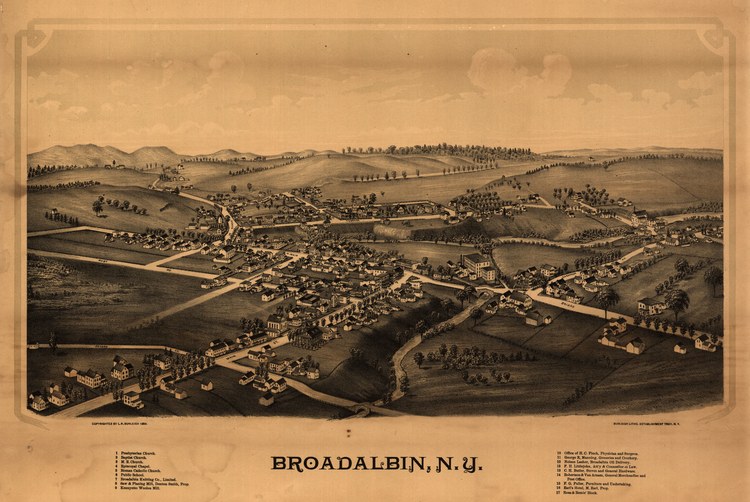
Fonda's Bush was the early name of a settlement in the wooded country northeast of Johnstown, in what is now the Village of Broadalbin, Fulton County, New York.
The name is directly associated with Major Jelles Douw Fonda (1727–1791), a prominent Mohawk Valley merchant, landholder, and Revolutionary War militia officer.
In his Trappers of New York (1871), historian Jeptha Root Simms described Fonda's Bush as a settlement named for Major Jelles Fonda, who had obtained a patent for lands in the region.
The word "bush" reflected frontier terminology for wooded country. Fonda's Bush therefore signified Fonda's Woods, referring to the dense forest that originally covered much of the surrounding landscape.
The locality stood approximately ten miles northeast of Johnstown and a comparable distance northwest of Amsterdam. It is geographically distinct from the present Village of Fonda on the Mohawk River, which was named for Jelles's father, Douw Jellis Fonda (1700–1780).
Early settlement and Revolutionary War history
Among the earliest documented inhabitants of Fonda's Bush was Henry Stoner, father of the celebrated frontier hunter and Revolutionary War veteran Nicholas Stoner.
Simms's account describes Henry Stoner moving his family into the region before the American Revolution, at a time when the country remained largely forested.
Other early settlers included members of the Scott, Deline, Helmer, Bowman, Salisbury, Putnam, Homan, and Cady families.
Like many other frontier communities, the settlement experienced considerable disruption during the Revolutionary War. Some settlers withdrew to more secure locations, and the development of the area resumed after peace returned.
The history of Fonda's Bush thus forms part of the wider experience of European settlement along the northern frontier of the Mohawk Valley.
The emergence of Broadalbin
The Town of Broadalbin was organized from the former Town of Caughnawaga in 1793, with its early town government established during 1793–1794.
The name Broadalbin was associated with Scottish settlers, particularly Daniel McIntyre, and derived from Breadalbane, a region of Scotland.
Although the settlement continued to be called Fonda's Bush, its post office was established under the name Broadalbin in 1804.
In 1815, an act of the New York State Legislature attempted to incorporate the village under the name Rawsonville, honoring local physician Dr. E. G. Rawson.
According to Roy John Honeywell's Broadalbin in History (1907), however, the act was never put into effect. The Rawsonville name nevertheless appeared in historical documents, while Fonda's Bush continued in local usage.
Horatio Gates Spafford's Gazetteer of the State of New York (1824) described Fonda's Bush as the principal village in the township. Situated along Fonda's Creek on the main road between Johnstown and Glens Falls, it contained 27 dwellings, 14 mechanics' shops, four stores, two tanneries, a paper mill, a schoolhouse, two taverns, an ashery, and a church.
This detailed description illustrates the transformation of an earlier wooded frontier settlement into an established commercial and agricultural community.
Fonda's Creek and the surrounding settlements
The historic place-name was also associated with Fonda's Creek, a stream identified in older local accounts with what is generally known today as Kennyetto Creek.
The creek supported early mills and other industries in the Broadalbin area, helping to sustain the settlement's economic development.
The broader region included smaller communities such as Vail Mills, formerly called Lower Bush or Lower Village in reference to the older Fonda's Bush settlement.
These related geographical names preserve evidence of the settlement patterns and naming traditions of the eighteenth and nineteenth centuries.
The Fonda family connection
Unlike places that acquired the Fonda surname through indirect associations or uncertain naming traditions, Fonda's Bush has a directly documented connection to a specific member of the family.
Major Jelles Douw Fonda was the son of Douw Jellis Fonda and a prominent figure in the Mohawk Valley during the colonial and Revolutionary periods.
His landholding activities extended beyond the Caughnawaga settlement, reflecting the increasing involvement of established Mohawk Valley families in the development of frontier lands.
The historical name Fonda's Bush illustrates the geographic reach of the Fonda family during the eighteenth century, while the later evolution into Broadalbin records the arrival of new settlers, industries, and community institutions.
Today, the name Fonda's Bush survives primarily in historical accounts, genealogical records, and local place-name research. It remains an important reminder of the family's presence in the early settlement history of what became Fulton County, New York.
Sources and references
- Broadalbin, New York — historic bird’s-eye map: Library of Congress historic Broadalbin view available through Wikimedia Commons.
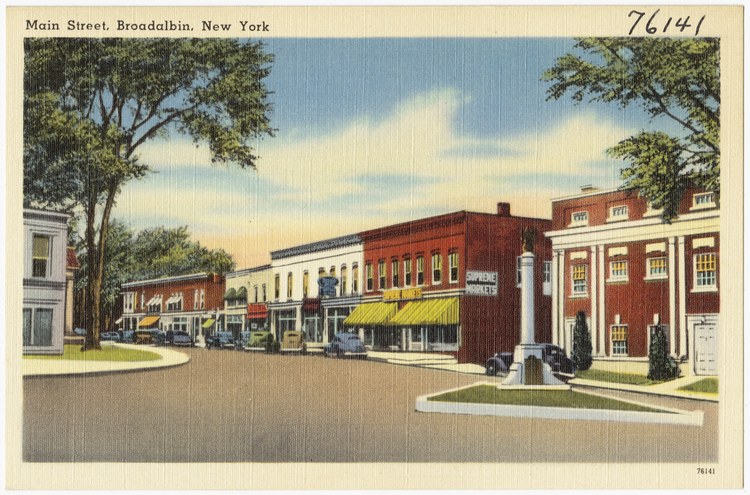
- Main Street, Broadalbin — historic postcard: Postcard image of Broadalbin’s main commercial street with file attribution.
- Jellis Douw Fonda — Fonda Family History: Family-history narrative concerning Jellis Douw Fonda and the Fonda’s Bush connection.
- Fonda Landmarks — The Fonda Blog: Survey of places named for the Fonda family, including Fonda’s Bush.
- History of Broadalbin (1907) — Fulton County NYGenWeb: Digitized local history of Broadalbin and its early settlements.
- French’s New York State Gazetteer — Broadalbin entry: Historical gazetteer excerpt for the town and its geographic identity.
- Town of Broadalbin Comprehensive Plan: Town planning document with geographic and historical background.
- Jeptha R. Simms: Trappers of New York (1871). Primary historical account explaining the Fonda's Bush name and Henry Stoner's settlement.
- Roy John Honeywell: Broadalbin in History (1907). Community development, early industries, Broadalbin post office and Rawsonville naming.
- French's Gazetteer of New York: Broadalbin. Town formation, settlement and early community descriptions.
- Town of Broadalbin Comprehensive Plan. Local background on the historic names and community geography
- Library of Congress: 1880 Broadalbin panoramic map. Provenance of the recommended primary illustration.