
A historic island in the Mohawk River
Fonda's Island was a small island in the Mohawk River near Schenectady, New York, historically associated with the early Dutch settlement of the region.
Its location is described in the land records preserved by historian Jonathan Pearson in A History of the Schenectady Patent in the Dutch and English Times (1883).
According to a patent dated August 9, 1694, the island lay north of the point known as the Hoek, south of the island then belonging to Joris Aertsen, and west of another island associated with Sweer Teunise.
The surrounding river flats and islands were important agricultural lands during the colonial period. They provided fertile soil for farming and formed part of the complex system of land grants and property holdings established following European settlement at Schenectady.
Early ownership and the 1694 patent
The earliest documented European owner identified in Pearson's account was Simon Simonse Groot, whose patent of August 9, 1694, confirmed his possession of the island.
The patent described Groot as having occupied the land for approximately twenty-seven years.
Ownership subsequently passed to Philip Livingston of Albany, a member of the prominent colonial Livingston family.
Around 1736, Livingston sold the island to Jellis (Jillis) Fonda, a Schenectady resident and gunsmith.
The island thereafter became known as Fonda's Island, preserving the name of its eighteenth-century owner.
Jellis Fonda and his family
Jellis Fonda, born about 1670, was the son of Douwe Jillise Fonda and Rebecca, and a grandson of the early Albany settler Jillis Douwese Fonda.
He married Rachel Winne, daughter of Pieter Winne of Albany, on December 11, 1695. The family moved to Schenectady around 1700, where Jellis established himself as a gunsmith and acquired several properties.
He was the father of Douw Jellis Fonda (1700–1780), who subsequently settled at Caughnawaga and became the namesake of the present Village of Fonda.
Jellis's descendants included merchants, farmers, craftsmen, military officers, and public officials who played important roles in the development of the Mohawk Valley.
Fonda's Island is therefore associated with an early generation of the family, before the better-known settlement at Caughnawaga.
The division of Fonda's Island in 1737
The island's most important family-history record is the will of Jellis Fonda, dated September 8, 1737.
According to Pearson's transcription and analysis of the property records, Jellis divided the island among three of his sons:
- Pieter Fonda: two morgens. - Abraham Fonda: four morgens. - Jacob Fonda: one morgen.
An associated two-morgen mainland parcel near Claas Graven's Hoek was devised to another son, Douw.
The division provides unusually specific evidence of the family's landholdings and inheritance arrangements in colonial Schenectady.
Pearson's historical account gives differing figures for the island's total area, describing it as five morgens in one section and seven in another. The precise original acreage therefore remains uncertain.
The island in later geographical history
The Mohawk River islands have undergone changes in their physical boundaries and names over successive centuries.
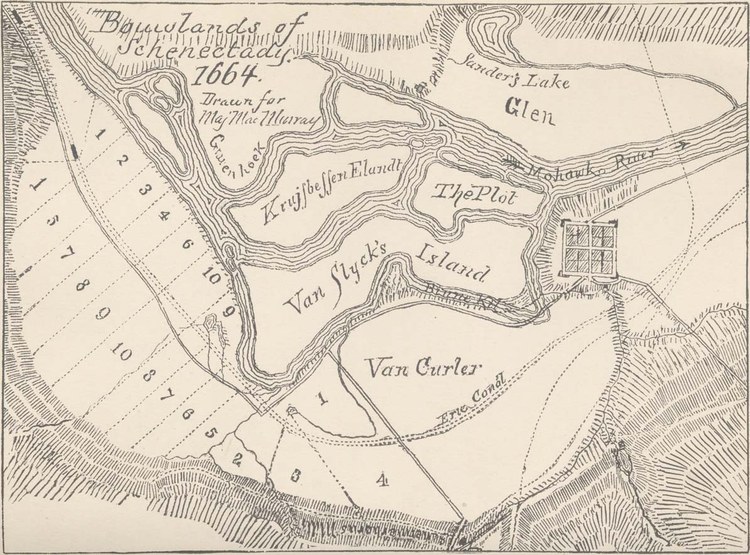
Historic maps record several neighboring islands under the names of their early owners, including Van Slyck's Island, Guise's Island, Gooseberry Island, and other small river properties.
The older Fonda Family History geographical inventory identifies Fonda's Island with part of the landform now known as the Isle of the Oneidas, west of downtown Schenectady.
Modern geographic records identify the Isle of the Oneidas as an island in the Mohawk River, also historically called Daley Island, Eldrich Island, and Eldridge Island.
Although the historical relationship is plausible, the precise boundaries of the original Fonda property have not yet been reconciled with present-day mapping.
The modern island's coordinates should therefore be regarded as an approximate geographic reference rather than a surveyed identification of the original eighteenth-century property.
Significance to the Fonda family
Fonda's Island provides a documented and unusually early connection between the Fonda family and the geography of the Mohawk River.
Unlike places that adopted the surname indirectly, the island was actually owned by an identifiable ancestor, and its division among his sons is preserved in a historical account of his will.
The property illustrates the family's participation in the agricultural and commercial development of colonial Schenectady and provides a geographical link between the earliest Albany generations and their descendants in the wider Mohawk Valley.
Its historical name remains an important part of the family's documented landholding history.
Sources and references
- Schenectady patent histories — chapter 6: Local land-patent history providing context for the Mohawk River islands.
- Fonda family land patent — Schenectady history: Historical land-record entry associated with the Fonda family.
- Schenectady Bouwlands map — historic landholdings: Historical map of early Schenectady farm and land parcels.
- Isle of the Oneidas — geographic feature listing: Geographic summary of the island in Schenectady County.
- Fonda Family History — Places Gallery: Historical images of Fonda-related places. The island’s identification and ownership history are documented by the Schenectady patent sources above.
- Jonathan Pearson: History of the Schenectady Patent, Chapter 6 — the 1694 patent and island ownership history.
- Bouwlands of Schenectady in 1664: contextual historical illustration.
- Modern Isle of the Oneidas geographic record: modern coordinates and alternative geographic names.