
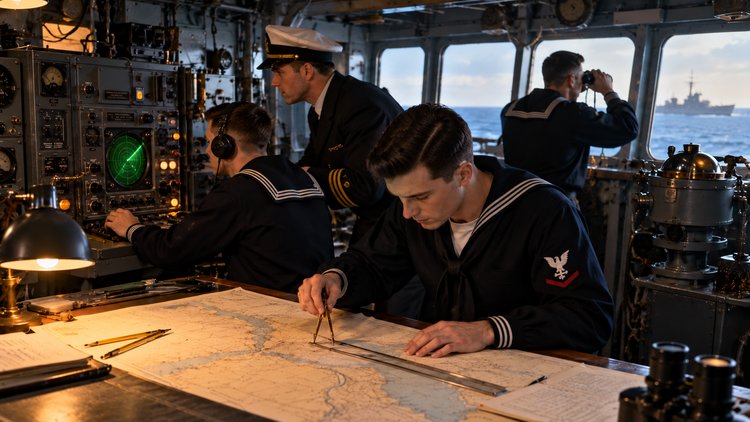
For a sailor, a coastline was once read from a familiar combination of charts, bearings, lights, weather, and the eye. The Second World War placed a new instrument in that world. Radar could find distant objects beyond ordinary sight, but someone still had to interpret what the instrument showed and make decisions from the information.
Gilbert Fonda brought an engineer’s training into naval service. According to his Princeton class memorial, he became a radar expert and served as an assistant navigator aboard the carrier Midway. The precise conversations on its bridge have not been preserved in the family account, so none need be invented. What matters is the nature of the responsibility: ships and crews now depended not only on seamanship but on rapidly developing electronics.
His work did not end with the war. He built a professional life around radar and marine navigation and eventually wrote a manual for other mariners. In his case, the technology of a world war became the business of peace. The story illustrates how far the Fonda family’s occupations had moved from the trading rooms, farms, and mills of its earlier generations.
Sources and references
- “Gilbert C. Fonda ’32,” Princeton Alumni Weekly, December 4, 2013. https://paw.princeton.edu/memorial/gilbert-c-fonda-32
- Gilbert C. Fonda and Hilliard L. Lubin, Marine Radar and How to Use It (Chester, PA: Operational Radar Service Publications, 1970); bibliographic confirmation: A. N. Cockcroft, review, The Journal of Navigation 24, no. 4 (October 1971): 573–574. https://doi.org/10.1017/S0373463300022451