
(1803-1871) Sources: Western Historical Manuscript Collection
Born in Wynantskill, Rensselaer County, NY; 1850, 1860 & 1870 Census, Louisville, Jefferson Co., KY; participated in a 1838 Jackson County, MO land sale (Prudhomme Tract) which eventually became Kansas City. Engaged in the family grocery business in the City of Louisville and owned two lots of land therein, also owned one tract of 320 acres of land in Orange County, MO per his will dated 1867. Married Fannie Stumbaugh 1844 in Van Buren (now Cass) County Missouri, remained a short time until returning to Kentucky. Had six children from 1847 to 1858.
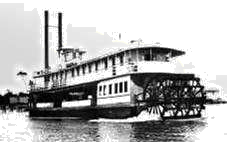
On February 1, 1831, French-Canadian fur trader Gabriel Prudhomme patented 271 acres of land in Jackson County, Missouri for $340. The land, originally part of the Louisiana Purchase of 1803, contained a natural rock ledge on the south bank of the Missouri River that would later be known as "the levee" that proved to be an excellent steamboat landing site. After an altercation in 1831, Prudhomme died leaving a complex legal battle among his heirs. The courts finally declared that the land should be auctioned-off and the proceeds equitably distributed among his children.
On July 7, 1838, James H. McGee as a guardian for the Prudhomme heirs auctioned the land. He received $1,800 for the land from Abraham Fonda but the courts ordered a new sale due to charges of a lack of adequate advertising and a suspicion of collusion between the two men. The land, including the landing for the loading and Mississippi River Steamboat unloading of materials on the Missouri River, had begun to be used regularly by businesses as early as 1836. The second auction of the estate was advertised as far away as St. Louis and cried-off on November 14, 1838. A group of men, led by William M. Sublett made a bid of $4,220 and successfully purchased the tract of land. Next, the group formed a corporation with the intent of using the landing and its nearby surroundings as a business settlement, complete with warehouses.
The corporation originally consisted of 14 members and shortly after the sale allowed an additional three members. Members included John C. McCoy (the city's first surveyor), Fry P. McGee (the group's first financial officer), and William M. Chick (Kansas City's first Postmaster). Other members of the group were: Oliver Caldwell, William Collins, Abraham Fonda, William Gillis, Russell Hicks, Samuel C. Owens, Jacob Ragan, James Smart, George W. Tate, and Moses G. Wilson. The additions were Robert Campbell, William B. Evans, and Henry Jobe.
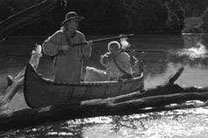
The initial order of business for the group was what to name the proposed town. The 14 committee members retired to the log house on the riverbank at the foot of Main Street occupied by "One-Eyed Ellis" to select a name for the new town. No doubt there was much laughter as those roughly dressed men sat in front of the blazing fire and suggested one name after another. Old Squire Bowers, a spectator who lived on the river, facetiously suggested "Rabbitville or Possumtrot" but was treated with silent contempt. Another suggested, "Kawsmouth" and " Port Fonda
" in honor of Abraham Fonda, then a prominent member of the committee. Unfortunately Fonda became involved in a quarrel with another part-owner, Henry Jobe, who threatened all sorts of legal, fistic, and even shotgun remedies, and the results were that "Port Fonda" was not accepted. Finally "Town of Kansas" was agreed upon, because of the Kansas River and the Kansas Indians, and was the name under which the new town site was surveyed and by which it was called until 1853. At that time it became known as the "City of Kansas" and in 1880, as "Kansas City."
Sources and references
- Western Historical Manuscript Collection: http://web2.umkc.edu/WHMCKC/Collections/IKC0352.HTM