
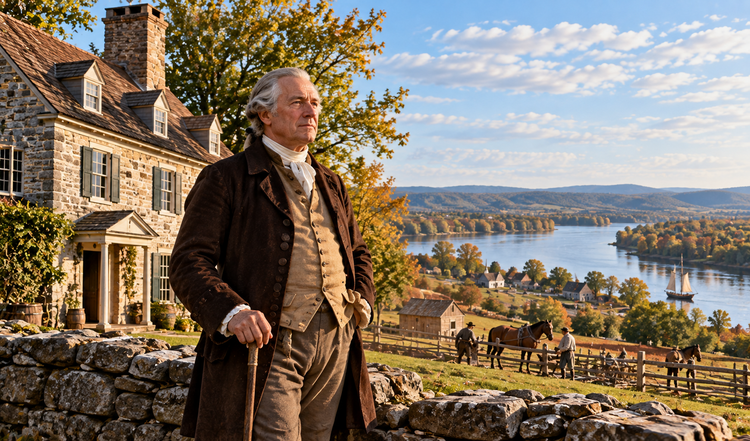
Douw was a dairy farmer, born in Schenectady, New York, a great-grandson of Dutch-born Jellis and Hester Fonda. Douw married, October 21, 1725, Maritje, daughter of the heroic Adam Vrooman, survivor of the Schenectady Indian Massacre in 1690. In 1751, Douw and family moved from Schenectady and settled in Caughnawaga, about 20 miles west. Standing on the flats between the present Mohawk Turnpike (now Route 5) and the Mohawk River, he resided in a large stone dwelling with a wing on each side. It had been the intention of the citizens to fortify the dwelling, and it was partially surrounded by strong pickets. Fonda's three sons, John, Jellis, and Adam, also good Whigs, were living in the neighborhood.
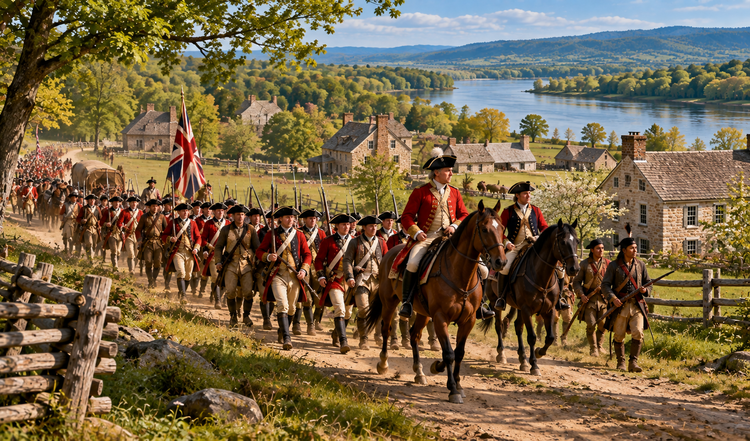
In May of 1780, British living in Canada heard that American authorities were organizing all Loyalists into a ranger corps and any refusing to join where imprisoned in irons. Sir John Johnson, whose late father, Sir William Johnson, had been Superintendent of Indian Affairs, settling his family in the Mohawk Valley decades earlier, decided to go to their rescue. The first houses were not burned as Johnson tried to keep their presence a secret but soon homes of the patriots were set on fire and inhabitants were killed. Attacks on Oneida Castle, Fort Plain and Johnstown devastated the south side of the Mohawk Valley. There were still habitations outside the forts to the west of Schoharie Creek but they certainly were now frightened. Johnson and his men got to Johnson Hall (in Caughnawaga) where he recovered two barrels of his family silver and other valuables. These had been buried prior to his hasty retreat from the area to Canada in 1776.
On May 22nd, the rumors became a reality when Sir John Johnson with about 500 Indians, Loyalists and British regulars entered the Mohawk District of Tryon County and burned Caughnawaga (present day Fonda area), Tribes Hill and Johnstown. Besides burning over one hundred buildings, Johnson took over fifty prisoners and many of them were local militia officers and men of influence such as the Fonda's and Sammons's. Johnson's forces of incendiaries also killed ten men and only one woman was known to have been tomahawked. This woman was the mother of Colonel Fisher but she soon recovered from the incident.
Some of those killed were Douw Fonda (a man of nearly eighty), Captain John and Harmon Fisher (brothers of the colonel), Lieutenant Hendrick Hanson, Corporal Amasa Stephens, Aaron and Lodowick Putman, William Gault and James Plateau (these last two men were loyalists). Colonel Fisher was tomahawked, scalped and left for dead but he not only survived his wounds like his mother but he lived a very active life afterwards serving as General of the Montgomery County Militia after the war and he died in 1809.
Major Jellis Fonda resided a short distance below the Caughnawaga Church, owning a large dwelling and store. At the time of this invasion, he was absent on public business. About a week previous, he sent part of his family and effects in a bateau to Schenectady, to which place they were accompanied by the wife and children of John Fonda. The wife of Major Fonda and her son Douw, were at home, however, on that morning. Hearing the firing at Visscher's and discovering the light of the burning buildings below, Mrs. Fonda and her son fled to the river, where there was a ferry. Remaining in the ferry-boat, she sent Douw to get two horses, and being gone some time, fears were excited lest he had been captured. As her apprehensions for her son's safety increased, she called him repeatedly by name. He returned with the horses and they began to cross the river, but had hardly reached its center when several of the enemy, attracted to the spot by her voice, arrived on the bank they had left. A volley of balls passed over the boat without injuring its passengers, and leaving it upon the south shore, they mounted their horses and directed their course towards Schenectady, where they arrived in due time.
Lt. Colonel Adam Fonda, at the time of Johnson's invasion, resided near the Cayadutta Creek. Arriving at Adam Fonda's, the enemy made him a prisoner, and fired his dwelling. Margaret, the widow of Barney Wemple, lived near Fonda, on a knoll not far from the creek, at which place she then kept a public house (inn). The enemy, making her son, Mina (short for Myndert), a prisoner, locked her up in her own dwelling
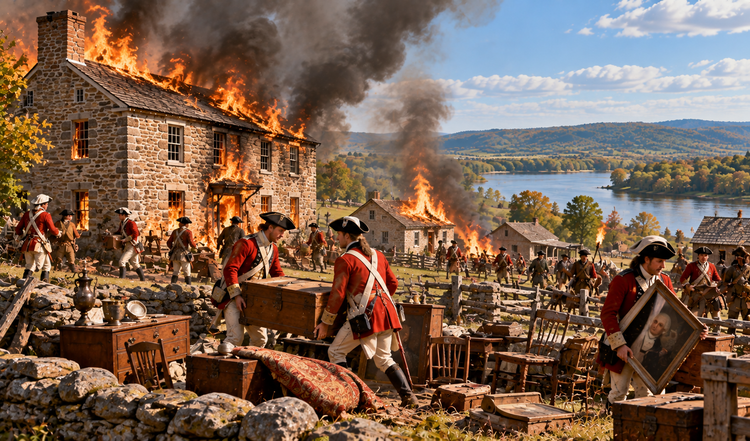
and set it on fire. From an upper window she made the valley echo to her cries of "murder" and "help," which brought some one to her relief. Her voice arrested the attention of Captain John Fonda, who sent one of his slaves round the knoll which formerly stood west of the Fonda Hotel, to learn the cause of alarm; but hardly had the slave returned, before the enemy's advance from both parties was there also, making Fonda a prisoner, and burning his dwelling.
The raiding party, on arriving at the dwelling of Major Fonda, plundered and set it on fire. There were then few goods in his store; but his dwelling contained some rare furniture for that period, among which was a musical clock, that; at certain hours. performed three several tunes. The Indians would have saved this house for the great respect they had for its owner, whom they had known as the warm personal friend of Sir William Johnson but their more than savage allies, the Tories insisted on its destruction. As the devouring element was consuming the dwelling, the clock began to perform, and the Indians, in numbers, gathered round in mute astonishment, to listen to its melody. They supposed it the voice of a spirit, which they may have thought was pleased with the manner in which they were serving tyranny. Of the plunder made at this dwelling, was a large circular mirror, which a citizen in concealment sew, first in the hands of a squaw, but it being a source of envy it soon passed into the hands of a stout Indian - not, however, without a severe struggle on her part. The Indians were extravagantly fond of mirrors, and it is not unlikely this costly one was broken in pieces and divided between them. Among the furniture destroyed in the house, was a marble table on which stood the statue of an Indian, whose head rested on a pivot, which, from the slightest motion was continually - "Niding, nodding, and nid, nid, nodding."
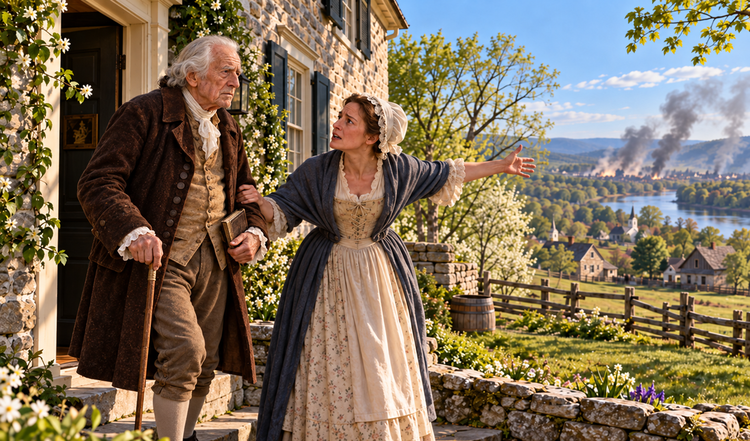
When the alarm first reached the family of Douw Fonda, Penelope Grant, a Scotch girl living with him, to whom the old gentleman was much attached, urged him to accompany her to the hill whither the Romeyn family were fleeing; but the old patriot had become childish, and seizing his gun, he exclaimed - "Penelope, do you stay here with me - I will fight for you to the last drop of blood!"
Finding persuasion of no avail, she left him to his fate, which was indeed a lamentable one; for soon the enemy arrived, and he was led out by a Mohawk Indian, known as "One armed Peter" (he having lost an arm), toward the bank of the river, where he was tomahawked and scalped. As he was led from the house, he was observed by John I. Hansen, a prisoner, to have some kind of a book and a cane in his hand. His murderer had often partaken of his hospitality, having lived for many years in his neighborhood. When afterwards reproved for his murder, he replied that as it was the intention of the enemy to kill him, "he thought he might as well get the bounty for his scalp as any one else!" Mr. Fonda had long been a warm personal friend of Sir William Johnson, and it is said that Sir John much regretted his death and censured the murderer. This Indian, Peter, was the murderer of Capt. Hansen, on the same morning. With the plunder made at Douw Fonda's were four male slaves and one female, who were all taken to Canada. Several other slaves were of the plunder made in the neighborhood, and doubtless became incorporated with the Canada Indians.
Sources and references
- Jeptha R. Simms, The Frontiersmen of New York, vol. II (Albany: G. C. Riggs, 1882), pp. 336–343 (retrospective account of the 1780 raid and Douw Fonda’s death).
- Millard E. Crane, A Historical Sketch of the Village of Fonda, N.Y., 1850–1950 (Fonda: Mohawk Valley Democrat, 1950), pp. 13, 15, 19, 25 (settlement, place-name and raid traditions; later local history).
- Jeptha R. Simms, History of Schoharie County, and Border Wars of New York (Albany: Munsell & Tanner, 1845), historical family account (older source; exact page to check).