
Family connection
Fonda, in Montgomery County, is one of the most important places in the history of the Fonda family. The village takes its name from Douw Jellis Fonda (1700–1780), who settled here about 1750 and operated a trading post near the Mohawk River. Local historical accounts describe the village’s earliest developed area as extending from the old church and parsonage toward Douw Fonda’s riverfront trading area. The place had long been known as Caughnawaga, and the eastern part of the village continued to be remembered by that earlier name.
Historical significance
The site of present-day Fonda was already historically important before the village took its present name. Caughnawaga was one of the notable places of the Mohawk Valley, associated with Mohawk settlement, early Dutch colonization, and later frontier life. In the eighteenth century the Fonda, Wemple, and Vrooman families were among the early Dutch families associated with the area, and local tradition preserved memories of mills, taverns, churches, and trading activity that made it a significant community before the Revolution.
Fonda’s place in family history is inseparable from the Revolutionary era. In the raid on Caughnawaga in May 1780, the settlement was attacked and burned, and Douw Fonda was killed. The village also preserves the memory of other connected figures, including Major Jelles Douw Fonda, a major landholder and militia officer, and Margaret “Peggy” Wemple, Douw’s daughter, who became a well-known frontier figure in local history.
In the nineteenth century the village developed into an important regional center. Local history credits its rise in part to its central location in Montgomery County and to the construction of the Utica and Schenectady Railroad, after which Fonda became the county seat in 1836. The village was incorporated in 1850, and over time became associated with the county courthouse, churches, schools, bridges across the Mohawk, manufacturing along Cayadutta Creek, and the transportation links that tied it to the wider Mohawk Valley.
Today Fonda remains historically significant not only as the namesake village of the family, but also as the setting for nearby associated sites such as the Caughnawaga Cemetery, Fonda Reformed Church, Fonda Fairgrounds, and the surviving Major Jelles Fonda House. For the family history website, it serves as the central place page from which many related people, stories, and locations can be connected.
Sources and references
- Village of Fonda / local historical sources: Current municipal and historical references.
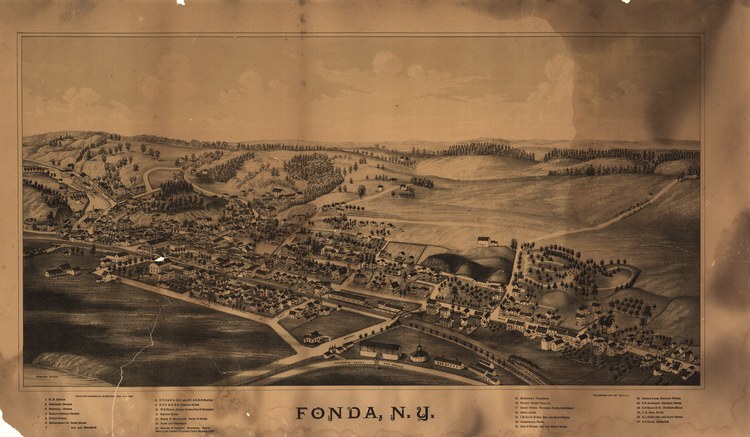
- Fonda, New York — 1889 bird’s-eye map, Library of Congress: Historic illustrated view of the village layout, streets and buildings.
- Village of Fonda — official municipal website: Present-day village information, services and municipal background.
- Fonda in Hudson-Mohawk local history: Regional historical reference on Fonda and the Mohawk Valley.
- Village of Fonda local history / historian materials: founder, county seat history, incorporation, churches, bridges, and village development.
- Village of Fonda official municipal website: confirms official status and incorporation date.
- History of the Mohawk Valley: Gateway to the West 1614–1925: useful for the broader Caughnawaga and Revolutionary-era context, including Douw Fonda and the 1780 raid.
- Library of Congress: 1889 panoramic village image.