
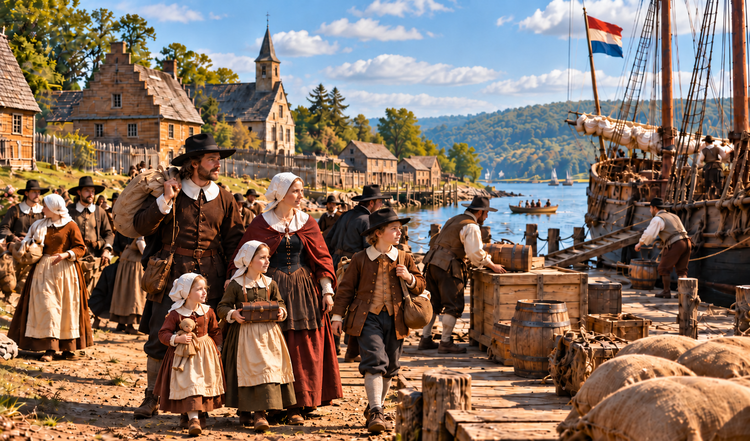
Albany was the second settlement in the 13 original American colonies, after Jamestown, Virginia. The Dutch, who built a fort there in 1614, called the place "New Orange", after the Prince of Orange. When the land was taken by the British in 1664, the name was changed to "Albany", in honor of the Duke of York and Albany, who later became James VII of Scotland and II of England. The Duke of Albany is a Scottish title given since 1398, generally to a younger son of the Scottish King. The name is derived from Alba; the Gaelic name for Scotland.
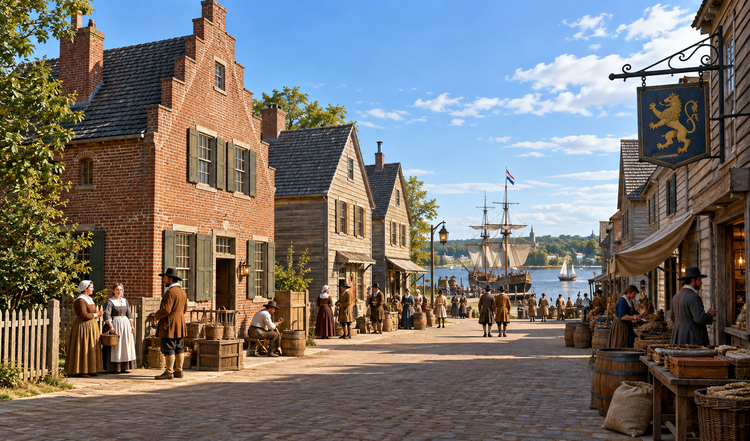
"Beverwyck" is the popular and mythical name given to the community of fur traders that first emerged along the river to the north of Fort Orange during the 1640s. The name came into official use in 1652 when the Dutch West India Company established a judicial jurisdiction for the land north of the trading post/fort. That act began a legacy of home rule for Albany that was primarily responsible for its development into a pre-urban center. Immediately following, the first houselots were parceled out. By the end of the decade, a log palisade had enclosed the settlement.
The Fonda Family was one of eighty-two distinct family groups representing the settler population of Albany at the end of the so-called Dutch period (1624-1686). Already, these urban dwellers were beginning to distinguish themselves from the farmers and husbandmen of the surrounding countryside. These families represented the largest number of New Netherlands family names in the city during its first two centuries of life. From this core group, a number of families left the Albany community, establishing new settlements at Schenectady, Kinderhook, Catskill, Schaghticoke, Hoosick, Saratoga, and beyond. Some became tenants of the Rensselaerwyck Patroon (cooperative). Others left the region entirely. Still others literally "died out" in the Albany setting. Those who remained formed the core population of what became the city of Albany in 1686.
Beginning during the 1670s and 80s, the children of the New Netherlands Dutch found marriage partners and raised American-born families of their own. The Albany community continued to grow and to feed the growth of the entire Hudson-Mohawk region based on the natural increase of its New Netherlands-ancestry settler stock. Although many people came and went, Albany's New Netherlands Dutch roots remained strong for another 200 years.
The Colonial Albany Project (New York State Museum) considers the census of 1790 second only to the census taken in 1697 in importance in defining early Albany's population. The 573 historically visible Albanians and the 2,925 other city people living in their households have been under study for almost two decades now. Their individual and collective stories are basic to the history of the community. The census of Albany Heads of Families taken by Sheriff Simeon Young in June 1697 listed two Fonda families: Jan & Maritje (Lookermans) Fonda and Jellis & Rachel (Winne) Fonda. These were the first two grandsons of patriarch Jellis Douwse Fonda (1614-1659). Both Jan and Jellis were Gunstockers by trade.
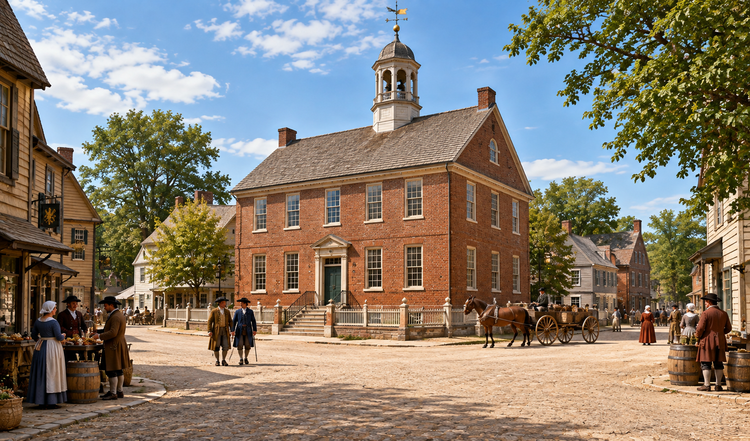
The first comprehensive census in America was conducted by the United States government beginning in August 1790. The census was taken by Federal Marshals reporting to the U. S. District Courts. Returns were due nine months later and were transmitted to Congress in October 1791. New York ranked fifth among the states with a population of 340,120 inhabitants - as in colonial times, Albany was by far the most populous New York county. Census data for Albany County included returns for nineteen districts, the town of Schenectady, an "Island in the river," and for the city of Albany. The total of 75,921 inhabitants marked a high point for the county as Rensselaer, Saratoga, and Greene Counties soon would be split off from Albany.
Rensselaerwyck was the most populated district with 8,318 total inhabitants. Watervliet (surrounding Albany city on the west side of the Hudson) was next with 7,419 total inhabitants. Although the center of activity in a booming region, the city of Albany itself, with 3,498 people, ranked no higher than sixth among Albany County jurisdictions. The city of Albany was credited with 573 heads of families - or an average household size of 6.1 people. By ward, the city population was distributed 1,612 people in the first ward; 878 in the second ward; and 1,004 in the third ward. There were 8 Fonda households listed in this survey; Nicholas, Jacobus, David, Hendrick, Isaac, John, Jacob and Abrahm.
Before the American Revolution, a Dutch village named Fonda had succeeded the Indian hamlet of Caughnawaga, along the Mohawk River, about 30 miles west of Albany. It extended from the rambling hills which comprise the Mohawk Valley, at the foot of which stood the church and parsonage, down to the river. Douw Jellis Fonda (1700-1780), father of the branch of the Fonda family so prominent in this neighborhood from the mid-1700's to the present, is considered the founder of this village, which now bears his name.
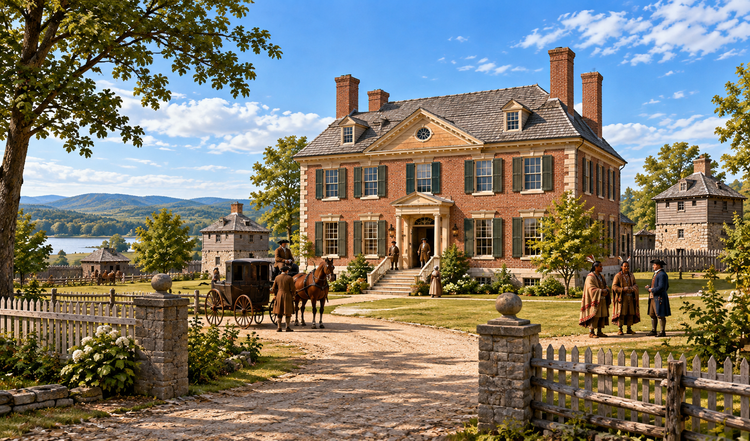
The present fairground of the Montgomery County Agricultural Society covers part of the site of old Caughnawaga, and when the ground was fenced and a race course was laid out and graded in 1927, some interesting relics of the old village were discovered. Among them were the remains of persons buried in the ancient graveyard, which were removed to the modern cemetery on the neighboring hills. Some, not interfered with by the necessary excavation and building, were left undisturbed. Several wells, partly filled up, were found on the premises, and traces of the cellars of a number of the old Dutch houses, including that of Douw Fonda. This house is spoken of as "a large stone dwelling with wings," and served as an inn for some time after Douw's death.
Douw Fonda came from Schenectady, New York and settled at this location in 1751. The tombstone of his wife (which was one that had been removed from the old graveyard on the fairground) bears the date 1756, and an epitaph in Dutch, believed to have been made in Holland: "As you pass by and see me lie, so once was I. Here lies the body of Mary Fonda, wife of Douw Fonda, born the 24th of March 1698. Departed this life in hopes of a better, 30th day of January 1756, age 58 years and 10 months."
Douw lived a long and prosperous life as a farmer and merchant. He was killed during a raid by the British Army, aided by the Mohawk Indians, on May 22, 1780; he was 79 yrs. old. His house was plundered and burned; and his sons, John and Adam, were taken as prisoners. Douw had been a close personal friend of the British constable, Sir William Johnson, and had always been on good terms with the Indians, but his life was taken as "heartlessly" as though he were an active enemy. His legacy remained through his abundant offspring, which included 6 children and 30 grandchildren.
Village Will Lower Flag in Honor of Henry Fonda August 13, 1982 - The Leader-Herald , Gloversville, New York
The village of Fonda will fly a flag at the Municipal Building at half-mast for 30 days in honor of the actor Henry Fonda whose ancestors founded the village. The actor's death yesterday once again has focused attention on the village of Fonda's legacy and its connection with members of the famous Fonda acting family. Though Jane Fonda visited the community in 1980, Henry Fonda never made a similar journey.
A local man who shares the Fonda name said he "was saddened by the actor's death." Edgar Fonda Jr. of Switzer Hill said "It kind of gave us a thrill every time we saw his name in an article." The Fonda couple said they had read the actor's autobiography. Of his films, Fonda said "On Golden Pond" was his favorite. Fonda said he believed he was a distant relative of the actor but had never figured out the relationship.
The late actor was interested in his ties to the village - his grandfather, Ten Eyck Hilton Fonda, resided in the original Fonda farm on the Fonda-Johnstown Road until 1873 - but he never visited the Mohawk Valley, according to Montgomery County historian Mrs. Anita Smith. Mrs. Smith said the actor's only known correspondence with the village came years ago in the form of a donation of a Fonda family Bible, found in an antique shop, to the village's Frothingham Free Library.
The actor was interested in his genealogy, enough so that he had his Dutch "roots" traced so he could qualify for membership in the Holland Society of New York City, Mrs. Smith said. She recalled that Fonda had a chance to visit upstate New York in 1977 when he was invited to speak at a Bicentennial celebration staged in Oriskany.
After Miss Fonda made a surprise visit to the village in July 1980, to trace her family tree, there was noticeable upsurge in interest in the village's history, the historian recalled. The actor had been invited to the event, in part, because of his famous starring role in the film, "Drums Along the Mohawk," she said. Mrs. Smith told The Leader-Herald that the Montgomery County Department of History and Archives has no plans to commemorate the late actor, though a letter of sympathy will be sent to Jane Fonda.
Miss Fonda's 1980 visit coincided with the 200th anniversary of the killing and scalping of Douw Fonda, her seventh great-grandfather and founder of the village. Accompanied by her two children and several cousins, she visited the Department of History and Archives displays and viewed a facsimile rubbing of the tombstone of Henry C. Fonda, a distant descendant.
Sources and references
- Amsterdam marriage banns of Jelle Douwes and Hester Douwes, 19 January 1641, with marriage notation at Diemen, 10 February 1641; transcription and English clarification by Harry Snijder (March 2009), based on a reproduced register image. The archival register identifier has not been independently established.
- Kerst Huisman, “The Fondas: Descendants of the Craftsman Jilles Douwes,” in Famous Frisians in America (Leeuwarden: Friese Pers Boekerij, 2009), pp. 111–112. Huisman recounts the Douwe Everts parentage hypothesis without treating it as documentary proof.
- Millard E. Crane, A Historical Sketch of the Village of Fonda, N.Y., 1850–1950 (Fonda: Mohawk Valley Democrat, 1950), pp. 7–9, summarizing Mohawk settlements and early colonial-era accounts, including the 1634–1635 journey of Harmen Meyndertsz van den Bogaert. Crane is a 1950 local secondary account, and some of its interpretations of Indigenous history are dated; it is cited here only for the documented longstanding presence of Mohawk communities, not as authority for its broader assessments.
- Berthold Fernow, New York in the Revolution (Albany: Weed, Parsons, 1887), p. 373, for named Revolutionary service records where applicable. The statement about Fonda family participation across wars follows the completed individual-service reconciliation, not a separately sourced family-wide total; no new aggregate is asserted here.
- New York State Museum: https://exhibitions.nysm.nysed.gov/albany/bios/f/fonda.html (legacy website reference; article-level relevance and current accessibility unverified).
- Wikipedia: http://en.wikipedia.org/wiki/Albany,_New_York (legacy website reference; article-level relevance and current accessibility unverified).