
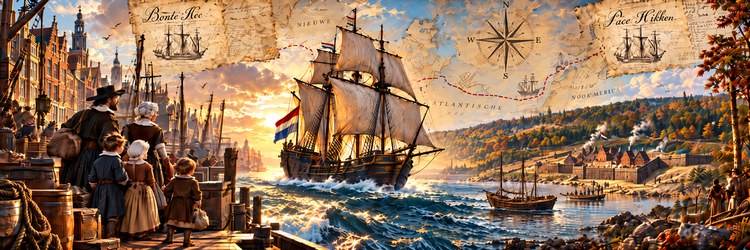
Although we do not know upon which ship Jellis Douw Fonda and family made their voyage to America, we can make an educated guess or at least narrow it down.
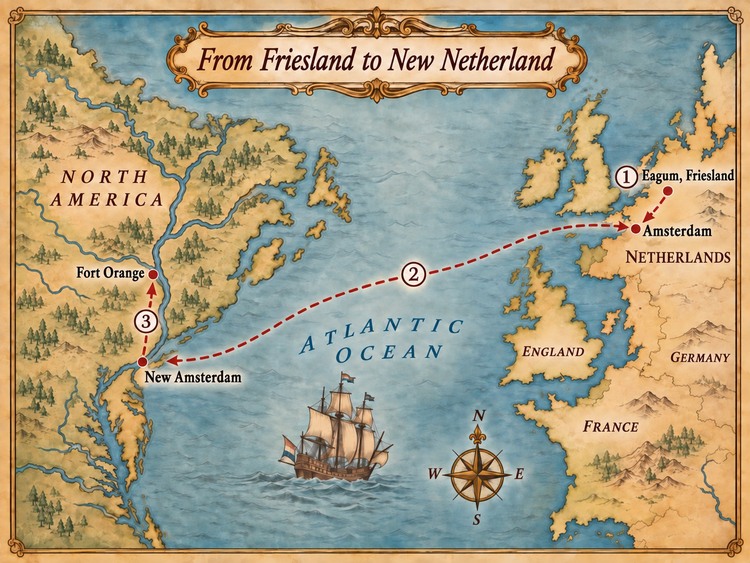
The following two facts serve as a window for the timing:
1. The youngest child of Jellis and Hester, Abraham, was baptized on April 14, 1647 in Amsterdam, Netherlands ("Amsterdam Records of the Fonda Family", The New York Genealogical and Biographical Record, Vol. 119, No. 1). He was buried on October 28, 1650 according to Amsterdam burial records. ("Famous Frisians in America", p. 108–109).
2. The first record of Jellis (Gillis) in America was in Fort Orange (now Albany, NY) on October 19, 1651 when he received permission from the court to distill liquor in Greenbush, a small village near Albany ("A Career Woman in 17th Century New York", The New York Genealogical and Biographical Record, New York, Vol. 95, No. 5).
So we know that the migration took place between November 1650 and October 1651.
According to "A Career Woman in 17th Century New York", when Jellis arrived in Fort Orange in 1651, "he was accompanied by his wife, Hester Jans, and three children, a son Douwe, aged about eleven years, and daughters Geertien and Sara, aged about nine and seven years, respectively".
No ship passenger lists have yet been found which show any names resembling Jellis/Gillis Fonda and his family. So, if you look at the ships that do not have passenger lists, maybe we can narrow it down some.
We know that Jellis did not enter into a contract with the Rensselaerswijck Colony (typically three to six year terms of farm labor in return for the ship's passage). He must have been a free colonist, paying for his own ship's fare, since he was not encumbered with any work contracts that we know of.
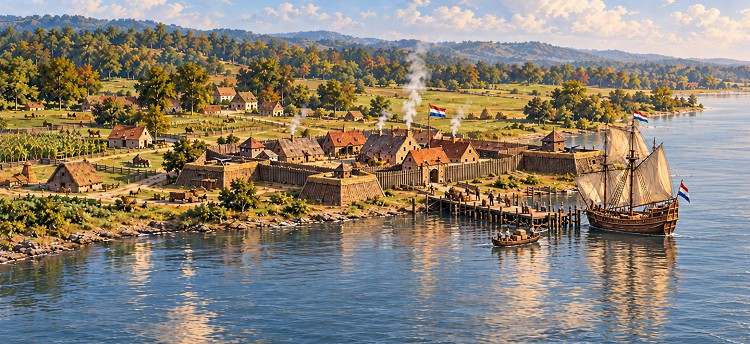
According to the Marine Museum (translated from the original Dutch by Willem Rabbelier and Cor Snabel of the Netherlands, published with their permission on The Olive Tree Genealogy pages):
"The book/thesis of Jaap Jacobs contains a list of about 500 ship crossings between Amsterdam, the Netherlands and New Amsterdam over the period 1609–1675. In only 56 cases the presence, but not the names, of colonists on board is mentioned."
De Scheepvaart En Handel Van De Nederlandse Republiek Op Nieuw-Nederland 1609–1675 by J.A. Jacobs (1989). See also Amsterdam–New Amsterdam ship records.
There were only five ships sailing from The Netherlands to America in 1651:
| # | Ship | Owner / master | Departure | Arrival |
|---|---|---|---|---|
| 1 | WATERHONT | particulier | Amsterdam 5 5 1651 | Nieuw-A'dam 1651 |
| 2 | BONTE KOE | particulier | Amsterdam 1651 | Nieuw-A'dam voor 13 6 1651 |
| 3 | HOFF VAN CLEEF | Adriaen Blommaert, particulier | Amsterdam 1651 | Nieuw-A'dam voor 15 6 1651 |
| 4 | GELDERSE BLOM | W. van Twiller | Amsterdam na 20 3 1651 | Nieuw-A'dam voor 31 7 1651 |
| 5 | PRINS WILLEM | Juryaen Andriessen, WIC | Amsterdam 1651 | Nieuw-A'dam voor 19 9 1651 |
| Explanation of Abbreviations Used | Translations of Dutch Words Used | |
|---|---|---|
|
VOC = Vereenigde Oostindische Compagnie VTC = Van Tweenhuysen Compagnie HCC = Hans Claesz. Compagnie WIC = West Indies Compagnie |
reder = ship owner bevrachter = loader vertrekplaats = place of departure aank. plaats = place of arrival datum = date na = after |
voor = before tussen = between eind = end of begin = beginning / early kort na = shortly after particulier = private owner |
Three had passenger lists which do not list any names resembling this family. The ships in this list which did not have passenger lists are:
| Ship | Owner / master | Departure | Arrival |
|---|---|---|---|
| BONTE KOE | particulier | Amsterdam 1651 | Nieuw-A'dam voor 13 6 1651 |
| PRINS WILLEM | Juryaen Andriessen, WIC | Amsterdam 1651 | Nieuw-A'dam voor 19 9 1651 |
So unless there are more ships that we don't know about, you can conclude that Jellis Douw Fonda, his wife Hester Jans and his three young children, Douwe, Grietje and Sara sailed on one of these two ships… the BONTE KOE or the PRINS WILLEM.
These are the only ships which fit in the correct time frame, from the correct location and do not have passenger lists.
Albert Mark Fonda
November 5, 2009
Sources and references
- Amsterdam baptismal-register image recording Douwe, son of Jelle Douwesz and Ester Douwes, with Annetje Jans as witness; transcription by Harry Snijder (2009).
- Kerst Huisman, “The Fondas,” in Famous Frisians in America (2009), p. 109, reports a burial-book entry dated 28 October 1650 for Abraham Gillisz. and identifies him only as probably the couple’s youngest son.
- New York State Archives, New York (Colony), Secretary of the Province, Register of the Provincial Secretary, 1642– 1660, Series A0270-78, vol. 3, documents 86l–86m (bond dated 19 June 1651) and 86n–86o (related bond, dated 19 June 1651), concerning merchandise in the Bonte Coe. These documents establish the ship’s presence at New Amsterdam, not the Fonda family’s passage.
- Marine Museum: https://www.olivetreegenealogy.com/nn/mm_intro.shtml (legacy website reference; article-level relevance and current accessibility unverified).
- 500 ship crossings: https://www.olivetreegenealogy.com/nn/mm_6.shtml (legacy website reference; article-level relevance and current accessibility unverified).
- Original blog article: https://blog.fonda.org/archives/1308 (legacy website reference; article-level relevance and current accessibility unverified).
- Mrs. John Spell, “A Career Woman in 17th Century New York,” The New York Genealogical and Biographical Record 95, no. 3 (July 1964): 129–137. (Biographical background on Hester Jans and her family; not independent evidence of their migration vessel or passage date.)