
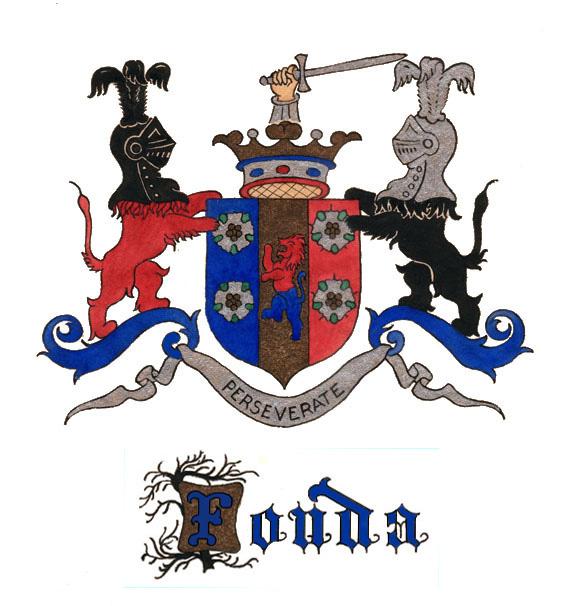
Languages:
Fonda (Latin) - foundation, base, support (also Funda)
Fonda (Spanish) - 1). bottom, foundation, source or beginning; 2). cafe or small restaurant; or 3). boardinghouse
Fonda (French) - charitable organization (foundation)
Note: Some name variations appear as Fondy, Fondey, Funda, Fundy, Fonde, etc. It is not uncommon to have phonetic misspellings in earlier records... or in some cases, intentional changes to differentiate or localize the spelling. There are also some more recent Fonda immigrants from Germany, Italy, Ireland and Austria, whose lineage is not from Jellis Fonda.
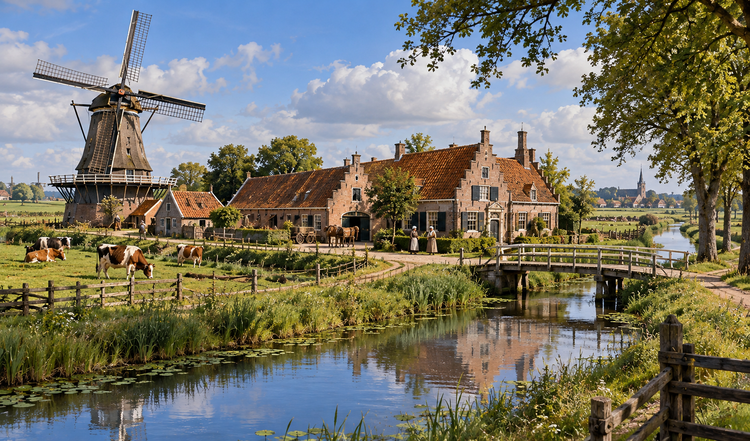
Foyngha, Netherlands — The New York Genealogical and Biographical Record, "Amsterdam Records of the Fonda Family" states: "In Frisian records van der Meer did not find any mention of the name Fonda, but in the vicinity of Kollum in northeast Friesland, where Benedictus Jacobse (Fonda) lived, he came across the names Banda, Ronda and Sinda. He also noted that in 1580 Benedictus was manager of an estate near Kollum called 'Foyngha,' and there was a chance that 'Fonda' was a corruption of that name." (Population: 15,983; 53º16'N, 6º9'E; Elev. 3 ft.)
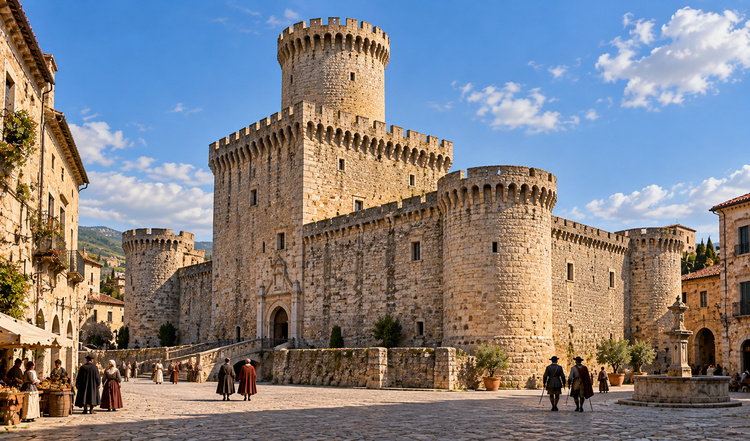
Fondi, Italy — So called from the Latin fundus, the bottom. Fondi is a town of Campania, Italy, in the province of Caserta, 12 miles NW of Formia. It lies 25 ft. above sea-level, at the north end of a plain surrounded by mountains, which extend to the sea. It occupies the site of the ancient Fundi , a Voiscian town, belonging later to Latium adjectum, on the Via Appia , still represented by the modern high-road which passes through the centre of the town. (Population: 24,647; 41º21'N 13º25'E; Elev. 6 ft.)
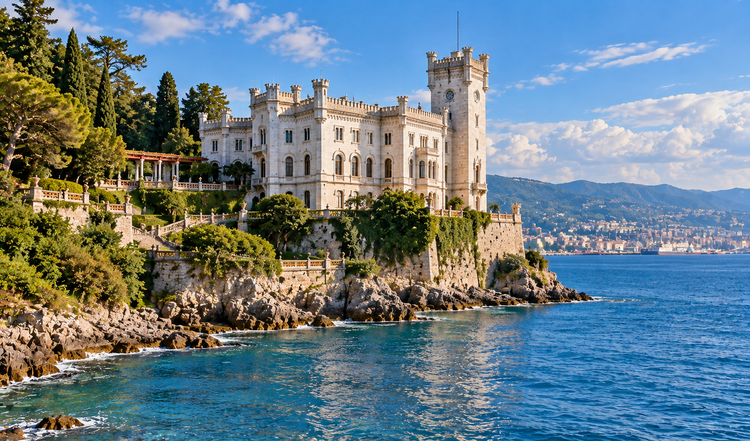
Trieste, Italy — The Fonda name may have originated from the town of Piran, Italy (first mentioned in year 1230 regarding Dominicus Fonda) on the NE coast of the Adriatic sea. Piran is now in Slovenia (former Yugoslavia). However, almost all Fonda's lived in Trieste, Italy, where today live more than 25% of the Fonda's in the world. According to legend, between about 1290-1360 AD lived tradesman " Latcho de Corgnale ", from Trieste. He is mentioned in years 1328, 1335 and 1347 as a tradesman with corn on the so called "Karsten Road", one of the most important European trade routes in the 14th century. Corgnale is today a village (with name Lokev - 500 inhabitants) in Slovenia (18 km from Trieste, Italy). In the middle ages, this village was on the trade route from Venezia and Trieste through Ljubljana and Celje (Slovenia) to Buda/Pest (Hungary) and Wien (Austria). Today near Celje is also small village named "Latkova Vas" (Latchos Village) where also live a few Fonda families. (Population: 78,587; 45º38'N 13º46'E; Elev. 357 ft.)

Genoa, Italy — extract from "Early American Families", Rev. W.A. Williams; Philadelphia, PA; 1916 "The Rensselaer-Bowier papers say that Douw Fonda was a Frisian, and Tacitus says that the Frisians dwelt along the coast of the North sea. They were converted to Christianity before A.D. 800. The family of Fonda was originally from the Republic of Genoa, Italy . The Marquis de Fonda was one of the leaders of a revolution in Genoa, having for its object the overturning of the aristocratic government , and putting the election of the Doge and Senate, into the hands of the people at large. The Doge (=duke) was the duke, or chief magistrate. Our ancestor was an early republican , and must have lived there, between 1339, when the first Doge was elected, and 1528 when the Dogate ceased. Baron de Fonda was unsuccessful in his attempt, and fled from the country, taking refuge in Amsterdam, Holland, whence his descendant, Jellis Douwese Fonda, emigrated to America in 1642, and had grants of land from the Dutch government, settling in or near the present city of Albany, N. Y. There is a perhaps less credible tradition also, that the Fondas were Huguenots . and fled from France to Holland after the massacre of St. Bartholomew’s night , Aug. 25, 1572. There is another tradition that they fled from Spain on account of persecution or followed the Duke of Alva to Holland. It is also said that they belonged to the royal house of Spain, fled to Italy, because of religious persecution, and came later to Holland. Possibly they fled from Italy to France, and from France to Holland. The form of the family name is Latin and therefore similar in French, Italian, and Spanish, indicating the Latin origin of the family, probably In Italy. The Fondas were Dutch Reformed Protestants when they emigrated to America, and must have been among the first converts of the Reformation. Their descendants are widely scattered throughout the Union, though many are still living near the old home in Eastern N.Y. The family name is taken from a deep valley in the Apennines, about 12 mi. from the city of Genoa, called Fonda, a name which means bottom, deep, foundation, etc. It is said that, in the early part of the last century, the estate was still in the possession of a branch of the family, the Count de Fonda, and there are many of the name, in the various parts of the Genoese territories.” Some of the family may have known Columbus in Genoa. (Population: 880,361 ; 44°25'N 8°54'E; Elev. 66 ft.)
Note: The above is disputed in "Old Dutch Families: Fonda Family" (De Halve Maen Quarterly, 1945):
"The Fondas were important in up-state New York during the Colonial period and in the early development of the State. Presumably the family is of Frisian origin and one genealogist has outlined European background for the Fondas giving them a really illustrious descent. However, these stories apparently come from tradition rather than substance. The emigrant ancestor of this family was Jillis (Jellis, Gillis) Douwese Fonda whose name first appears in Albany records in 1651 and last in 1654. His only son, Douw Jellise, became the ancestor of all Fondas in this country."
Sources and references
- Kerst Huisman, “The Fondas: Descendants of the Craftsman Jilles Douwes,” in Famous Frisians in America (Leeuwarden: Friese Pers Boekerij, 2009), pp. 111–112. Huisman recounts the Douwe Everts parentage hypothesis without treating it as documentary proof.