
On a January day in 1641, a journeyman smith from Friesland entered the written record of Amsterdam with the woman he intended to marry. His name was Jelle Douwes. Hers was Hester Douwes. Neither was yet known to history as a Fonda, and nothing in the marriage entry foretold that their descendants would one day spread across America.
The banns, dated 19 January, tell a small story with surprising precision. Jelle came from Agum—Eagum, a Frisian village—and was living on Bickers Island, in a district shaped by Amsterdam’s waterside commerce. Hester lived on the Keizersgracht, one of the city’s canals. The banns describe both as appearing without their parents; a further annotation indicates Jelle’s parents had died. Hester was assisted by her stepmother, Elsgen Douwes, but the entry does not establish whether both her biological parents were deceased. These are dry details on a page until one considers what they meant: two young adults navigating marriage and family obligations in a large and unfamiliar city.
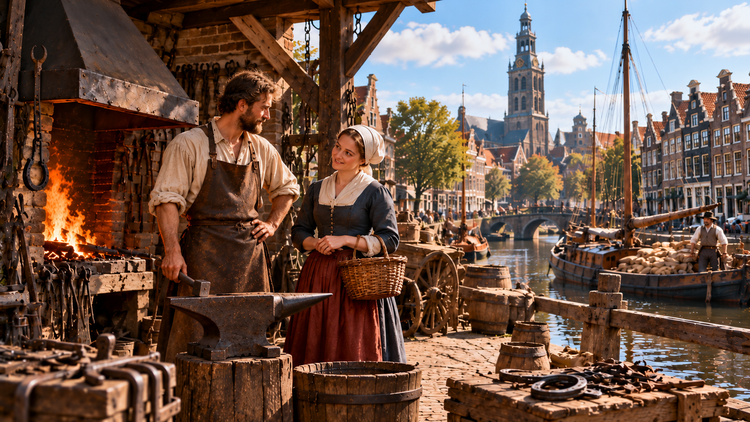
Jelle was described as a journeyman smith. His trade connected him to practical, indispensable work: tools, iron fittings, repairs, and the busy material life of a port. Yet the record does not say whether he enjoyed the craft or how he first met Hester. We can place them on the Amsterdam map, but we cannot supply the conversations they had.
The register says the couple married at Diemen on 10 February 1641. Within the years that followed, Amsterdam records would associate them with children and household losses. A decade later, Jelle—then more often rendered Gillis or Jellis—would appear in New Netherland. For now, the moment belongs to an apprentice and his bride: two names carefully entered in a book, on the threshold of a life that neither document nor descendant can fully recover.
Sources and references
- Amsterdam marriage banns of Jelle Douwes and Hester Douwes, 19 January 1641, with marriage notation at Diemen, 10 February 1641; transcription and English clarification by Harry Snijder (March 2009), based on a reproduced register image. The archival register identifier has not been independently established.
- Mrs. John Spell, “A Career Woman in 17th Century New York,” The New York Genealogical and Biographical Record 95, no. 3 (July 1964): 129–137. (Biographical background on Hester Jans and her family; the Amsterdam marriage record is the direct evidence for the wedding.)